
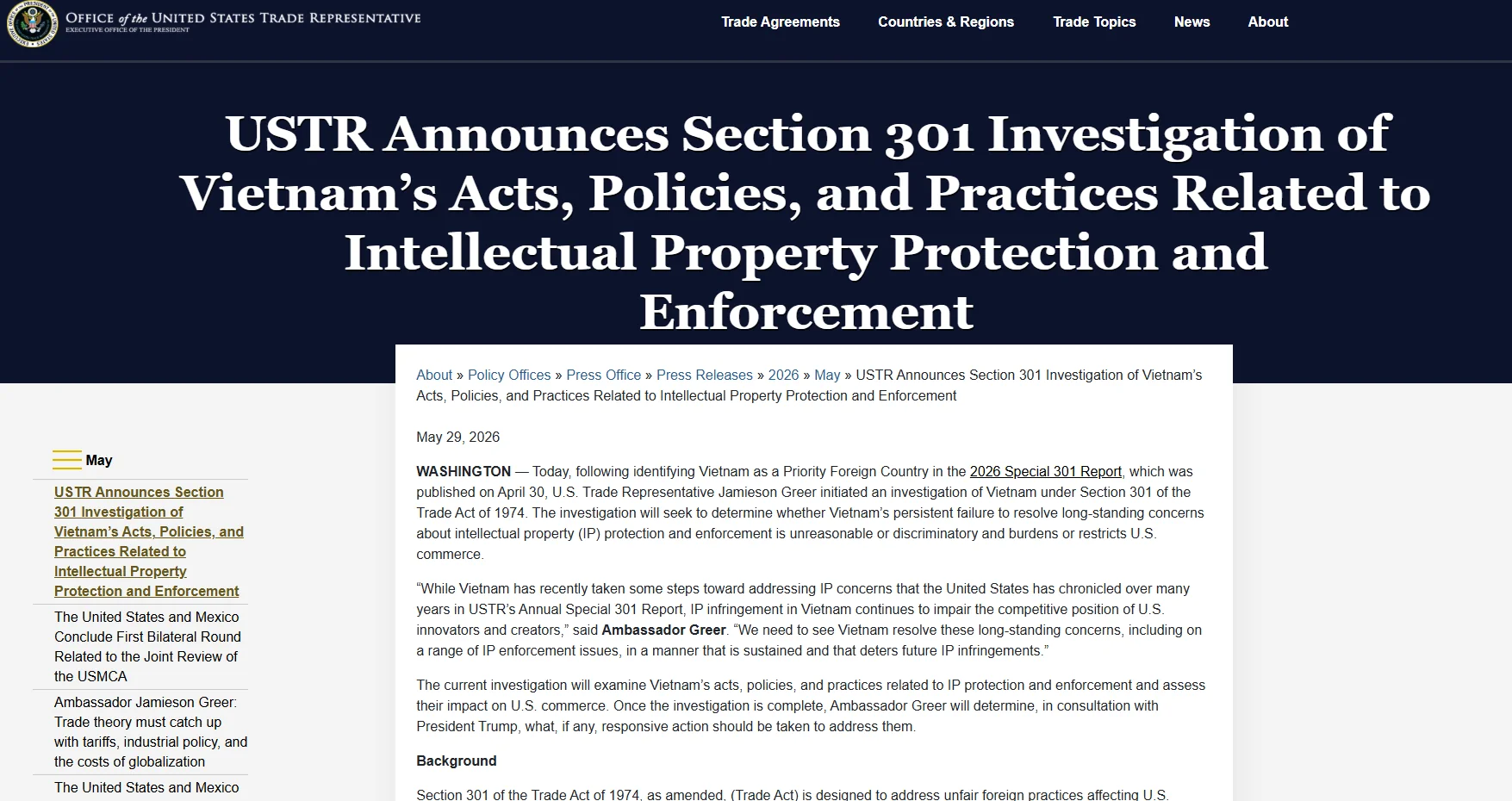
At a glance: On May 29, 2026, the U.S. Trade Representative formally initiated a Section 301 investigation into Vietnam’s intellectual property protection and enforcement practices. The probe follows Vietnam’s designation as a “Priority Foreign Country” in USTR’s 2026 Special 301 Report and may ultimately lead to tariffs or other trade measures — adding a new layer of uncertainty to U.S.–Vietnam trade flows.
Background: What Is a Section 301 Investigation?
Section 301 of the Trade Act of 1974 is a broad legal authority that empowers the U.S. Trade Representative to investigate and respond to foreign trade practices deemed “unreasonable, unjustifiable, or discriminatory” that burden or restrict U.S. commerce. Historically, Section 301 investigations have served as a precursor to significant trade measures — most notably the sweeping tariffs applied on Chinese imports beginning in 2018.
The mechanism gives USTR considerable flexibility: outcomes can range from negotiated bilateral agreements and voluntary commitments, to formal sanctions, quantitative restrictions on imports, or additional tariffs on goods originating from the country under review.
Why Vietnam Now?
The United States has raised intellectual property concerns with Vietnam through its annual Special 301 Report for a number of years. On April 30, 2026, USTR elevated Vietnam to the status of “Priority Foreign Country” — the most serious designation in the Special 301 framework — citing Vietnam’s ongoing failure to resolve longstanding issues related to IP protection and enforcement.
“While Vietnam has recently taken some steps toward addressing IP concerns that the United States has chronicled over many years in USTR’s Annual Special 301 Report, IP infringement in Vietnam continues to impair the competitive position of U.S. innovators and creators.”
— Ambassador Jamieson Greer, U.S. Trade Representative, May 29, 2026
Key areas of concern include inadequate enforcement against online piracy and counterfeit goods, insufficient protection for pharmaceutical data, and limited market access for rights holders. According to the Federal Register notice, Vietnam has “failed to make meaningful progress” on these issues in bilateral engagement since at least 2020.
Timeline of Key Events
Scope of the Investigation
The investigation will examine whether Vietnam’s acts, policies, and practices related to IP protection and enforcement are unreasonable or discriminatory and whether they burden or restrict U.S. commerce. USTR is specifically soliciting public input on the following areas: Vietnam’s specific IP-related policies and practices; whether those practices are unreasonable or discriminatory; the nature and level of burden on U.S. commerce; and what actions, if any, would be appropriate — including tariff and non-tariff responses.
The investigation is premised on Section 301(b) of the Trade Act, which addresses practices that are unreasonable or discriminatory — a standard that gives USTR broad interpretive latitude in assessing impact on U.S. commerce.
Potential Implications for Supply Chains and Trade
Vietnam has become a critical node in global supply chains over the past decade, particularly as manufacturing activity shifted away from China following the tariff actions of 2018–2019. The country is a major production hub for electronics, footwear, textiles, and machinery — goods that flow in significant volumes through U.S.-bound trade lanes.
Businesses and shippers should take note of several considerations. Any new tariffs resulting from this investigation would apply to goods imported from Vietnam, with potentially substantial cost implications for importers in affected categories. The public comment period, open through July 2, 2026, represents a direct opportunity for industry stakeholders to formally submit evidence on how their operations may be affected. Companies with sourcing or manufacturing in Vietnam should begin scenario planning, particularly in sectors with significant IP components such as pharmaceuticals, software, and branded consumer goods. A negotiated outcome remains possible — USTR may use the investigation as leverage to secure concrete enforcement commitments rather than proceed to formal sanctions. Logistics and freight operators should also monitor for any shifts in commodity flow patterns, as trade policy uncertainty tends to accelerate supply chain reconfiguration activity.
Vietnam’s Position and Likely Response
Vietnam has been aware of U.S. IP concerns for some time and has, according to USTR, taken incremental steps to address them. The formal designation as a Priority Foreign Country and the subsequent Section 301 investigation represent a significant escalation in diplomatic pressure, however, and will likely prompt Vietnamese authorities to accelerate reform commitments in targeted areas.
Both governments have a mutual interest in preserving the robust bilateral trade relationship that has developed over the past decade, which may constrain the likelihood of a maximalist tariff response. That said, the outcome remains contingent on the pace and credibility of Vietnam’s remedial measures, as well as the broader U.S. trade policy environment under the current administration.
What Comes Next
Once the public comment period closes on July 2, 2026, USTR will review submissions and complete its investigation. The agency will then present findings and recommendations to President Trump, who retains ultimate decision-making authority over any responsive trade action under Section 301.
Given the current administration’s established willingness to deploy tariffs as a negotiating instrument, businesses should not discount the possibility of substantive trade measures — even if a negotiated settlement ultimately proves more likely in the medium term.
Voltrans will continue to monitor developments in this investigation and will publish updates as the situation evolves. If you have questions about how this may affect your import operations or supply chain strategy, our trade advisory team is available to assist.